
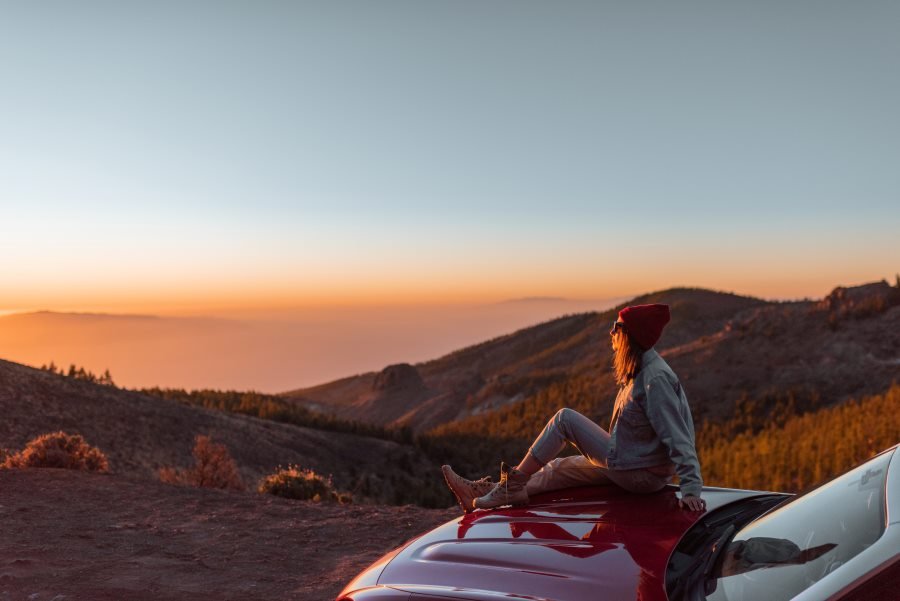
There is a very specific feeling that arrives sometime during a first solo trip. It might come on the second day or the fifth. It might come while you are sitting at a cafe table with nothing but your notebook and a cup of coffee. It might come when you are navigating an unfamiliar train station and everything works out exactly as it should. It might come at the end of a long walking day when you arrive somewhere beautiful and the only person you need to share it with is yourself.
The feeling is difficult to name precisely. It is something between freedom and confidence and a quiet kind of pride. You are somewhere new, you got yourself here, and you are entirely responsible for everything that comes next. Nobody is helping you navigate the decisions. Nobody is managing the logistics. Nobody is checking in on whether you are happy. You are doing it all yourself and discovering, possibly for the first time, that you are entirely capable of doing it.
This is the gift that solo travel gives and it is genuinely difficult to receive in any other way. You can read about independence. You can practice it in small ways in your ordinary life. But there is something about the combination of an unfamiliar environment, complete self-reliance, and the absence of everyone who knows you that produces a specific kind of self-knowledge and self-confidence that travel with others, for all its pleasures, simply cannot deliver in the same way.
Solo travel has grown dramatically as a category over the past decade. More people than ever are choosing to travel alone, including women, older travellers, and first-time international travellers who are discovering that the world is both more accessible and more welcoming than their anxieties about travelling alone suggested it would be. The infrastructure that supports solo travel has grown in response. The community of people who do it and who share their experiences online has made the knowledge required to do it well more widely available than ever before.
This blog is going to cover solo travel honestly, practically, and enthusiastically. What it actually feels like, why people do it, how to plan and prepare for it well, the destinations that are particularly well-suited to solo travellers, the safety considerations that deserve genuine attention, and what the experience gives back to the people who have the courage to try it.
Why People Choose to Travel Alone
The decision to travel solo usually comes from one of a small number of starting points and it is worth understanding them because they reflect something genuine about what different kinds of people are looking for.
For many solo travellers the starting point is simply that nobody else could come. The holiday dates aligned with availability, the destination appealed strongly, and the choice was between going alone or not going. People who take the not-going option for years until the circumstances for group travel align sometimes discover that the circumstances never quite align and the travel never quite happens. People who go anyway discover that travelling alone is not just a compromise but something genuinely better in many respects than they expected.
For others the choice is more deliberate. They have been on group trips and enjoyed them but they carry a specific awareness of how much of a group travel experience is shaped by accommodation of other people’s preferences, other people’s pace, and other people’s interests. The experience of solo travel, where every decision about where to go, what to see, where to eat, when to rest, and how long to linger somewhere belongs entirely to you, is something they actively want to experience rather than something they arrive at by elimination.
For a significant and growing number of people, solo travel serves a specific purpose that it is uniquely well-positioned to serve. The person navigating a major life transition, the end of a relationship, the loss of a job, the completion of a long educational programme, a significant birthday or anniversary, often finds in solo travel a container for the reflection and recalibration that the transition requires. Being away from your ordinary life and your ordinary social context, with time and space to think, to process, and to begin forming a new sense of direction, is something that solo travel provides in a concentrated and powerful way.
For young people at the beginning of their adult lives, solo travel provides a compressed course in self-reliance, problem-solving, and the development of the confidence that comes from managing unfamiliar situations successfully. The skills built through solo travel, navigating bureaucracies in foreign languages, managing budgets under real conditions, making decisions without a support network, recovering from things going wrong, are transferable to every other area of adult life in ways that are genuinely significant.
What Solo Travel Actually Feels Like
Describing the experience of solo travel honestly requires acknowledging both its genuine pleasures and its genuine challenges, because both are real and both are part of what makes the experience as transformative as it is.
The freedom is the first and most frequently cited pleasure. The absence of negotiation about where to go and what to do next is something that solo travellers describe as almost physical in its relief. You are hungry, so you eat. You are tired, so you rest. You pass a temple that interests you and you stop and stay as long as you want. You are in a city and you decide to take a train to a smaller town two hours away because it appealed to you in a travel blog you read six months ago. All of this happens on your terms, at your pace, without reference to anyone else’s preferences or schedule.
The quality of observation changes when you travel alone. When you are with other people, your attention is partly on the people you are with, the conversation, the shared reactions, the social management of the group dynamic. When you are alone, your attention turns fully outward to the place you are in. You notice more. You observe the details of daily life around you more carefully. You are more likely to be approached by local people because a solo traveller is more approachable than a group and you have more space and time for those interactions than a traveller focused on the social dynamics of their own group.
The people you meet when you travel alone are one of the most consistently cited pleasures of the experience. Travelling without a ready-made social group makes you naturally more open to connection with other travellers and with local people. The conversations that start at hostel common room tables, at guesthouse breakfasts, on long train journeys, at sunset viewpoints where two strangers discover they are both looking at the same extraordinary thing, happen with a frequency and a depth that group travel does not produce in the same way.
The loneliness is also real and it would be dishonest to describe solo travel without acknowledging it. There are evenings in unfamiliar cities when the meal is good and the evening is beautiful and you very much wish there was someone to share it with who already knew you. There are difficult moments when something goes wrong and the absence of a companion who could help you think through the solution is genuinely felt. There are days when the freedom of having no fixed plan produces not liberation but a low-level anxiety about direction and purpose that is its own particular challenge.
These difficult moments are part of the experience too. Learning to sit with your own company in uncomfortable states, to work through them rather than escaping into distraction or company, is one of the things that solo travel teaches that nothing else teaches in quite the same way. The person who emerges from a solo trip knowing how to manage their own company in both pleasant and difficult states has gained something genuinely valuable.
Planning Your First Solo Trip: Where to Begin
The planning of a first solo trip is one of the most common points at which the desire to travel alone either converts into action or fades back into vague intention. Getting the planning right for a first trip is important both for safety and for the quality of the experience.
Destination choice for a first solo trip matters more than for subsequent ones. A destination with good tourist infrastructure, a well-established traveller community, a reasonable level of safety for independent travellers, and the availability of the kind of accommodation that makes solo travel comfortable and social is a better starting point than an ambitious remote or challenging destination. You are building confidence as well as having an experience and a destination that rewards beginners reduces the friction of the first experience.
For Indian travellers, the domestic options for a first solo trip are genuinely excellent. Rishikesh is one of the most consistently recommended first solo destinations for Indian travellers. The town has a well-developed backpacker and solo traveller infrastructure, is extremely safe for independent travellers, offers a range of activities from yoga and meditation to white-water rafting, and has a social environment in hostels and cafes that makes meeting other solo travellers almost effortless. Hampi in Karnataka, McLeod Ganj in Himachal Pradesh, Pondicherry in Tamil Nadu, and Coorg in Karnataka are all destinations with similar characteristics.
For international solo travel, Thailand has been a rite of passage for solo travellers from across the world for decades and continues to be one of the most welcoming, most accessible, and most enjoyable solo travel destinations available. The combination of good budget accommodation with strong social culture, excellent food at every price point, straightforward independent transport, English-language accessibility, and the extraordinary warmth of Thai hospitality toward solo travellers makes it an ideal first international destination.
Building a flexible itinerary rather than a rigid schedule is advice that applies to all travel but is particularly important for solo travel. The ability to extend your stay somewhere that turns out to be wonderful, to move on early from somewhere that does not resonate, and to change direction in response to something you hear about from another traveller is one of the specific advantages of solo travel and it is lost if you have pre-booked every night of accommodation and committed to an inflexible schedule.
Booking the first few nights of accommodation before you leave provides the safety and the mental comfort of knowing where you are going when you land or arrive, while leaving subsequent nights open for decision-making on the ground. This balance of structure and flexibility is the approach that most experienced solo travellers have settled on as optimal.
Safety: What You Actually Need to Know
Safety is the concern that most commonly holds people back from solo travel and it deserves honest, practical attention rather than either dismissal or amplification of fear.
The practical reality is that most of the world is significantly safer for independent travellers than the anxieties people carry about it suggest. Solo travellers make millions of trips every year to destinations across every continent and the vast majority of those trips are completed entirely safely. The people who go and come back consistently describe a world that is more welcoming and more helpful than they expected.
This does not mean that safety requires no attention. It means that safety attention should be practical and specific rather than generalised anxiety that prevents the trip from happening at all.
Researching the specific safety situation in your destination before you go is the foundation of practical safety preparation. Government travel advisories, recent traveller accounts on forums and communities, and the specific safety considerations for the activities you are planning are all part of informed preparation. Understanding which areas of a city are safest for solo travellers to stay in, which transport options are reliable and which require more caution, and what the common scams and safety challenges are in your specific destination allows you to take appropriate precautions without being overwhelmed by generalised fear.
Sharing your itinerary with someone at home, a family member or close friend, and checking in regularly throughout your trip provides both a practical safety mechanism and the peace of mind for the people who care about you that reduces the emotional cost of your absence. A simple daily or every-other-day message that confirms you are well and states where you are maintains this connection without requiring any significant investment of time or effort.
Accommodation choice is particularly important for solo travellers from a safety perspective. Staying in well-reviewed, centrally located accommodation where other travellers are present and where the front desk staff are responsive provides a safety net that isolated, poorly-reviewed properties in unfamiliar locations do not. Reading recent reviews specifically for comments about safety, about the helpfulness of staff in addressing issues, and about the quality of the surrounding neighbourhood is worth the additional research time.
Trust your instincts. This is advice that appears in almost every serious discussion of solo travel safety because it reflects something genuinely important. Human beings have well-developed instinctive responses to situations and people that feel wrong and those instincts are worth listening to. If a situation feels uncomfortable, removing yourself from it without explanation or apology is always the right choice. If a person’s behaviour feels off in a way you cannot quite articulate, creating distance from them is appropriate even without being able to specify the problem exactly.
For solo female travellers specifically, safety considerations require additional thought in certain destinations without that thought converting into a reason not to travel. Women travel solo to every destination in the world and do so successfully and enjoyably. The precautions that make solo female travel safer, researching destination-specific safety considerations for women, staying in well-reviewed female-friendly or mixed accommodation, dressing in ways that respect local norms, being clear and direct in declining unwanted attention, and connecting with other female travellers for shared experiences in areas of uncertainty, are all manageable and practical rather than limiting in their impact on the travel experience.
Solo Travel as a Path to Self-Knowledge
The self-knowledge dimension of solo travel is something that people who have done it describe consistently and in terms that make it clear they are not exaggerating. There is genuinely something about travelling alone that produces insights about yourself that other kinds of experience do not generate as efficiently.
When you are alone in an unfamiliar environment with complete responsibility for your own decisions and experience, aspects of your personality and character that are usually masked by the social roles you inhabit at home become visible. You discover how you respond to frustration when there is nobody to absorb it or commiserate with. You discover what genuinely interests you when the influence of other people’s preferences is absent. You discover how patient you are, how resourceful you are, how comfortable you are with uncertainty, and how well you manage the inevitable difficult moments that travel produces.
You also discover things about what you value and what you want that the noise and busyness of ordinary life makes it difficult to hear. The conversations you seek out when you are free to seek any conversation tell you something about what you are genuinely curious about. The choices you make about how to spend unstructured time tell you something about what genuinely matters to you when there is no performance required for an audience. The thoughts that surface in quiet moments, on long train journeys, in the space before sleep in an unfamiliar place, are often the thoughts that most need attention and that the pace of normal life has been preventing you from hearing.
Many people describe returning from solo travel with a clarity about direction, priorities, and values that they had been struggling to find before they went. Not because travel itself contains answers but because the conditions of solo travel, the removal from ordinary context, the presence of your own company as the primary social relationship, and the concentrated experience of managing your life from scratch in an unfamiliar environment, are uniquely effective at surfacing what is actually true for you beneath the layers of habit, expectation, and social performance.
Practical Tips That Make Solo Travel Better
Beyond the larger principles, several specific practical habits and approaches make solo travel both safer and more enjoyable.
Staying in hostels, at least for part of a solo trip, provides social infrastructure that independent accommodation does not. The common areas of good hostels, the communal kitchens, the shared dormitories, the organised social events, all create conditions for meeting other solo travellers in a natural, low-pressure way. Many solo travellers who began by being skeptical about hostel culture have become its most enthusiastic advocates after discovering that the community it provides is one of the most reliable antidotes to the loneliness that solo travel can produce.
Learning a few words of the local language, even just greetings, expressions of gratitude, and a handful of practical phrases, has an effect on how local people respond to you that is disproportionate to the modest effort required. The willingness to attempt communication in someone’s own language, however imperfectly, signals respect and interest that people consistently appreciate and that opens doors that would otherwise remain closed.
Eating at communal tables in restaurants and cafes, rather than requesting a table for one in a corner, increases the probability of interesting conversation and connection with other travellers or with local people. Many solo travellers make the friends who share significant portions of their trip over a shared meal table rather than through any more deliberate social effort.
Keeping a journal, whether physical or digital, is a practice that many solo travellers describe as one of the most valuable habits they developed while travelling alone. Writing about what you have seen and done, about the conversations you have had and the decisions you have made, serves both as a record you will value later and as a form of processing that makes the experience more conscious and more integrated. The act of writing about what you are experiencing tends to deepen it and the journal you create is a document you will return to for years.
Solo Travel in India for Indian Travellers
Indian travellers have access to one of the most extraordinary solo travel playgrounds in the world in their own country and the domestic solo travel community has grown significantly in recent years with a corresponding growth in the infrastructure and resources that support it.
The hostel culture in India has developed to a degree that would have seemed remarkable a decade ago. Properties in Rishikesh, Hampi, Goa, McLeod Ganj, Manali, Pushkar, and the major cities now offer genuinely excellent hostel accommodation that rivals the best in Southeast Asia in terms of social culture, activity programming, and the quality of the traveller community they attract. Indian solo travellers exploring their own country on a budget have better accommodation options available to them than any previous generation.
The train network provides the backbone of affordable solo travel in India in a way that has no equivalent in most other countries. The shared experience of overnight train travel, the conversations with fellow passengers, the chai vendors at stations, and the changing landscape outside the window create a social and experiential richness that air travel entirely lacks. Solo travellers who embrace the train rather than flying between destinations are choosing the better experience as well as the more affordable one.
Solo female travel within India is a specific topic that deserves honest engagement. India has real challenges for solo female travellers in certain contexts and certain locations and those challenges should be acknowledged rather than minimised. At the same time, millions of Indian women travel solo domestically every year and do so with varying degrees of comfort and success depending on destination choice, preparation, and the networks and communities they connect with. The growing community of Indian solo female travellers sharing their experiences online has made the practical knowledge needed to travel safely and enjoyably as a woman in India more accessible than ever before.
Conclusion
Solo travel is one of the most genuinely transformative experiences available to anyone who is willing to step out of their comfort zone and into an unfamiliar world on their own terms. It is not for everyone and it is not right for every trip. But for the people who try it and for the specific things it offers, there is no adequate substitute.
The freedom it provides, the self-knowledge it generates, the confidence it builds, and the connections it creates with people and places in ways that group travel cannot quite replicate are all genuinely valuable. The challenges it presents, the loneliness, the uncertainty, the complete responsibility for your own experience, are not just tolerable. They are, in retrospect, among the most important parts of what makes the experience so formative.
The practical barriers to solo travel are lower than most people who have not tried it believe. The world is more accessible, more welcoming, and more navigable for independent travellers than the anxieties that accumulate around the idea of going alone typically suggest. The infrastructure for solo travel, the hostels, the communities, the booking platforms, the shared knowledge of millions of people who have gone before you and documented what they found, is better than it has ever been.
You do not need a companion to travel. You do not need a group. You do not need perfect conditions or perfect confidence or a perfect plan. You need a destination that interests you, a reasonable amount of preparation, the practical precautions that any sensible traveller takes, and the willingness to go.
What you find when you go alone will surprise you. How capable you are will surprise you. How open the world is to you when you are open to it will surprise you. How well your own company serves you when you give it the chance will surprise you most of all.
Go alone. At least once. And see what you find out there and in yourself when there is nobody else between you and the world.
It is one of the best decisions most people who make it ever make.