
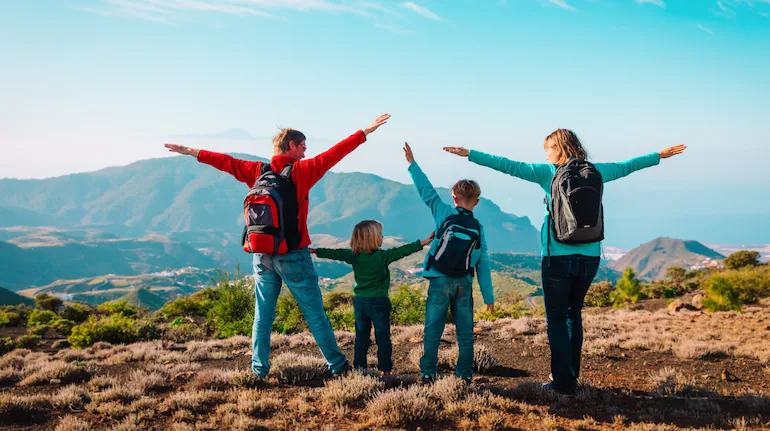
There is a particular kind of chaos that belongs only to family travel. The bag that was definitely packed is somehow missing a key item. The child who was perfectly fine ten minutes ago is now carsick. The toddler who slept through every night at home has decided that hotel rooms are interesting enough to explore at two in the morning. The teenager has earphones in and is communicating entirely through shrugs. And somewhere in the middle of all of it, one or both parents are simultaneously navigating, managing, and trying to remember whether they actually booked the activity for tomorrow or just thought about booking it.
And yet family travel is one of the most consistently rewarding things that families do together. The memories created on trips taken together are disproportionately durable compared to the hours and money invested in creating them. Children who travel with their families carry those experiences through their entire lives. The beach where something funny happened. The mountain they climbed together when legs were tired and someone nearly turned back but did not. The market in a foreign city where they tried something new and discovered they liked it. The hotel pool that seemed infinitely better than any pool they had ever been in before simply because everyone was there together.
Family travel is worth doing and worth doing well. But it requires a different kind of planning from solo travel or even travel as a couple. The needs of multiple generations travelling together, the energy levels and attention spans of children at different ages, the logistics of managing more people through airports and stations and unfamiliar cities, and the challenge of creating an experience that works for everyone simultaneously, all of these require thought and preparation that pays back in a trip that runs more smoothly and delivers more of what you were hoping for.
This blog is going to cover family travel practically and honestly. How to choose the right destinations for different family compositions and ages. How to plan trips that balance what parents want with what children need. How to manage the logistics that family travel involves. How to handle the inevitable difficult moments and the unexpected changes of plan. And how to get the most out of the experience of travelling together as a family.
Understanding What Each Family Member Actually Needs from a Trip
The first and most important principle of good family travel planning is honest clarity about what each person in the family genuinely needs from the experience, because those needs vary significantly depending on age, temperament, and what each person finds genuinely enjoyable.
Small children, roughly the under-five age group, need routine above almost everything else. They need regular meals at predictable times, adequate sleep in conditions that are reasonably comfortable, and a pace of activity that does not consistently exceed their energy and attention. When travel disrupts their routine significantly and consistently, the result is a child who is miserable and whose misery affects everyone else in the group. The most common mistake parents of small children make in travel planning is trying to do too much and move too fast, resulting in a trip that is exhausting for the adults because the children are continuously overtired and overwhelmed.
Primary school children, roughly five to twelve, are genuinely adventurous and genuinely enthusiastic about new experiences when those experiences are presented in ways that engage them. Children of this age are interested in how things work, in animals and nature, in history when it is presented through stories and tangible things rather than abstract information, and in activities that give them a genuine sense of challenge and achievement. Travel with children in this age group has enormous potential because their enthusiasm is real and their memories are sticky. A wildlife safari, a snorkelling trip, a visit to a historical site with the right story attached to it, a cooking class where they actually make something, all of these land with children in this age range in ways that produce lasting memories.
Teenagers are the category that family travel planning discussions often avoid because the honest answer is that travelling with teenagers is genuinely complicated. Teenagers need some degree of autonomy, some independence from family activities, and some acknowledgement that their preferences and interests matter in the planning of the trip. A teenager who is dragged through an itinerary designed entirely around what their parents find interesting, with no input into what they do and no independent time, is not a willing participant in the experience. A teenager who has been genuinely consulted, who has had some role in shaping the itinerary, and who has some time that is theirs to use according to their own preferences is a fundamentally different travel companion.
Adults travelling with the family need something too, and it is worth naming this explicitly because parents sometimes lose sight of it in the planning focus on what the children need. Parents need some moments of genuine relaxation and enjoyment that are not entirely subordinated to the needs of the children. A trip in which one or both parents spend the entire time managing, organising, and ensuring that everyone else is having a good time without ever having a good time themselves is not sustainable and is not what family travel should be.
Destination Choice: Matching Place to Family
The choice of destination is the most important single planning decision in family travel because the wrong destination for a particular family creates problems that no amount of good planning can fully solve, while the right destination makes almost everything easier.
Destinations with good family infrastructure, which means accessible and safe environments, a range of activities suited to different ages, reliable medical facilities if needed, accommodation designed to accommodate family groups comfortably, and food options that children will actually eat, are genuinely different propositions for family travel than destinations where none of these things apply.
Beach destinations remain one of the most consistently successful categories for family travel because the beach itself is an activity. Children can be entertained at the beach for hours with almost no adult planning or input required beyond supervising their safety. The combination of water, sand, and the natural environment of a beach provides a genuinely open-ended space for play that younger children in particular find endlessly absorbing. Adults can relax in a way that is difficult in more activity-intensive destinations because the beach provides its own entertainment for the children.
For Indian families, the beaches of Goa remain one of the most popular and most practically sensible family travel choices in the country. The combination of reliable infrastructure, good accommodation options across price points, calm waters in the right season, and a wide range of food options including options that children with limited food adventurousness will accept makes Goa a destination that works reliably well for families. The beaches of the Andaman Islands offer a more remote and more pristine version of a similar proposition for families willing to invest in the longer journey.
Kerala is another destination that works exceptionally well for families. The backwaters houseboat experience is genuinely engaging for children who find the novelty of living and sleeping on a boat an adventure in itself. The wildlife sanctuaries and elephant encounters available in Kerala are among the most accessible in India. The food is excellent and relatively adaptable. And the overall pace of Kerala travel tends toward the gentle rather than the frantic, which suits families better than destinations that require constant movement.
Hill stations are a category of destination that many Indian families discover is much more effective for family travel than they expected. Destinations like Coorg, Ooty, Munnar, Shimla, Mussoorie, and Nainital offer cool temperatures, beautiful landscapes, manageable activity options, and a pace that allows genuine rest alongside genuine exploration. For families travelling in summer when the heat of the plains becomes difficult, the predictable quality of a well-planned hill station trip is not to be underestimated.
For international family travel, Southeast Asia has established itself as one of the most practical and most enjoyable regions for families travelling with children. Thailand in particular has a well-earned reputation as one of the world’s most family-friendly international destinations. The warmth with which Thai culture regards children, the quality and variety of the food, the cleanliness and comfort of the accommodation at most price points, the range of child-friendly activities available including elephant sanctuaries, cooking classes, and beach and water activities, and the relatively low cost of everything compared to European or North American alternatives make Thailand an excellent choice for families who want international travel that does not require maximum effort to make work.
Packing for the Family: The Art of Bringing Less and Being Happier
Family travel packing is an area where the gap between what is brought and what is actually needed tends to be enormous, and where the consequences of over-packing are felt most painfully on every transit between locations.
The principle that applies to all travel but applies most forcefully to family travel is that you will carry everything you bring. Every extra item of clothing, every toy brought to maintain entertainment, every just-in-case item packed because someone felt anxious about being without it, adds physical weight to bags that adults carry and mental weight to the experience of moving between places. Developing the discipline of packing less than you think you need is a skill that repays the initial discomfort of leaving things behind every time you lift your bag at a station or an airport.
Children’s clothing can be washed and re-worn. Most travel destinations have shops where anything genuinely essential that was forgotten can be replaced at modest cost. A child entertained by three interesting activities will not be meaningfully less entertained than a child who has fifteen activities available. The comfort of lighter bags and less cluttered accommodation generally outweighs the anxiety of travelling with less than feels sufficient.
Carry-on only travel for families, where it is possible given the duration and nature of the trip, eliminates checked baggage entirely and with it the cost, the waiting, and the anxiety of potentially separated luggage. Families who transition to cabin-only packing consistently describe the experience of travel as qualitatively better, not despite travelling with less but because of it.
A specifically dedicated children’s travel bag that older children carry themselves has both practical and developmental value. Children who are responsible for carrying their own entertainment, their own spare clothes, and their own personal items develop a sense of ownership and responsibility for the trip that changes their engagement with it positively. It also distributes the physical load more fairly.
Keeping Children Engaged on Long Journeys
The long transit, whether by plane, train, or car, is one of the aspects of family travel that generates the most parental anxiety before the trip and the most creative problem-solving during it.
The honest starting point is that no approach completely eliminates the challenge of a long journey with young children. What good preparation does is reduce the frequency and intensity of the difficult moments and increase the proportion of the journey that passes comfortably and even enjoyably.
For flights with young children, choosing seats that give the family access to the aisle without climbing over other passengers reduces the friction of the repeated toilet trips, leg stretches, and movement that young children need. Bulkhead seats with bassinet access for infants are worth requesting at booking for families travelling with babies. Bringing an entirely new small toy or activity that the child has not seen before preserves the novelty factor for the journey rather than arriving with familiar items whose entertainment value has already been spent.
For train journeys, which are a significant part of family travel within India, the shared compartment of a sleeper or AC class train car provides more physical space for children to move in, more social stimulus from fellow passengers who in Indian train culture are genuinely and warmly interested in children, and the natural interest of watching the landscape pass at a pace that allows it to be registered and discussed.
Road trips with families require frequent stops built deliberately into the schedule rather than treated as interruptions to the driving. The stop at the roadside dhaba for tea and a stretch, the brief exploration of something interesting spotted from the road, the pause at a viewpoint, all of these are part of the journey rather than departures from it. Road trips that are planned as a series of experiences rather than as an exercise in covering distance produce a fundamentally different quality of experience for children and adults alike.
Tablets loaded with downloaded content for offline use are a practical reality of modern family travel and there is no need to be apologetic about using them. Screen time in transit is a different context from screen time in place and the ability to keep a young child absorbed on a long flight without disturbing other passengers is worth the occasional parenting compromise it represents.
Managing Meals on the Road with Children
Food is one of the areas where family travel creates the most consistent friction, particularly when children have limited food adventurousness and the destination’s cuisine does not offer obvious alternatives to what they are comfortable eating.
The most effective approach to managing children’s food while travelling is gradual rather than all-or-nothing. Insisting that children eat whatever the destination offers regardless of their reaction produces miserable meals and exhausted parents. Restricting children to only familiar food removes one of the genuine benefits of travel, the broadening of food experience, entirely. The middle ground that most experienced family travellers find is creating a structure where some meals are genuinely exploratory and some are reliably comfortable.
Most destinations offer some food that children universally find accessible. Rice is eaten everywhere. Bread exists in every culture. Noodles and pasta appear across multiple cuisines. Fruit is universally available. Building one or two meals per day around these reliable options while making other meals the occasion for trying new things gives children a degree of food security that makes them more willing to engage with new things rather than less.
Involving children in food choices when practical, by taking them to a market and letting them choose something, by asking them to identify something on a menu that looks interesting, by giving them the task of finding the best chai or the best lassi in the destination, converts food from a potential battleground into a genuine element of the travel experience that produces its own memories.
Handling the Inevitable Difficult Moments
Family travel produces difficult moments. This is not a sign of bad planning or bad parenting. It is simply a reflection of the fact that travel is inherently unpredictable and that children’s physical and emotional states are more variable and less manageable than adults would prefer.
The parent who approaches difficult travel moments with genuine flexibility and genuine humour rather than with frustration at the departure from the plan is not just a better travel companion in that moment. They are modelling a relationship with uncertainty and challenge that is one of the genuine educational gifts that travel offers children. The disrupted plan that becomes an unexpected adventure, the missed bus that leads to an interesting delay in an interesting place, the rain that ruins the beach day but produces an afternoon exploring a local market, all of these produce their own memories and their own lessons.
Maintaining realistic expectations about how much can be accomplished with children in a given day prevents the specific kind of exhaustion and disappointment that comes from ambitious itineraries that children’s bodies and attention spans cannot sustain. A family that sees three things slowly and fully is having a better day than a family that rushes through seven things and arrives at the evening meal exhausted and short-tempered.
Building in genuine downtime, afternoons at the accommodation with no particular agenda, days with nothing scheduled, time around a pool or on a beach with no planned activities, is not wasted travel time. It is the time during which children process and integrate their experiences, during which the family consolidates as a unit, and during which the adults actually get some rest. Over-programmed family trips are among the most common sources of the feeling that you need a holiday from your holiday.
The Memories That Family Travel Creates
The lasting value of family travel is in the memories it creates and those memories have a particular quality that is worth understanding because it affects how you plan and what you prioritise.
Research on memory and experience consistently finds that people remember peaks and endings more than they remember the overall average of an experience. The most dramatic, most unexpected, most emotionally significant moments of a trip are what stick. Not the smooth, comfortable, everything-went-according-to-plan moments but the moments when something remarkable happened, whether it was wonderful or difficult or both at the same time.
This has a practical implication for family travel planning. Investing in a small number of genuinely exceptional experiences within a trip, the wildlife encounter that nobody expected to be that moving, the local festival that you happened upon, the meal that was so good that everyone went quiet, the physical challenge that was harder than expected and more satisfying for it, creates the peaks that become the family stories told for years. An itinerary built around two or three genuinely peak experiences surrounded by comfortable, lower-key days is likely to create more durable family memories than an itinerary of uniformly pleasant but unremarkable experiences.
Involving children in the documentation of trips, through their own photographs, through keeping simple travel journals, through collecting mementoes that they choose rather than parents choose for them, gives children ownership of the memory-making process that increases both their engagement during the trip and the durability of the memories they form.
Conclusion
Family travel at its best is one of the most valuable investments a family can make in its shared life. The time spent away from ordinary routines, in new environments, with the focus of everyone’s attention on shared experience rather than on the parallel lives that modern family schedules often produce, creates a quality of togetherness that is genuinely different from what daily life provides even when that daily life is rich and loving.
The memories of family trips last across lifetimes. The beach where something unexpected and funny happened. The train journey where a fellow passenger adopted the whole family for the duration of the ride. The mountain that required genuine effort to climb and produced genuine pride when it was climbed. The meal that was so good it became the reference point against which all subsequent meals in that cuisine were judged. These are the experiences that families refer to years and decades later as the defining moments of their shared history.
Getting family travel right requires honest planning that starts from what each family member actually needs rather than from an idealised image of the trip you want to have. It requires destination choices that work for the specific ages and temperaments in your family rather than choices made for any generic family. It requires the flexibility to adapt when things do not go according to plan and the humour to find the story in the difficult moments rather than only the frustration.
It requires travelling slower than you think you need to, doing less than you have packed into the itinerary, building in more downtime than feels justifiable, and prioritising a small number of genuinely exceptional experiences over a larger number of adequate ones.
And it requires remembering, in the middle of the chaos that family travel reliably produces, that the chaos is part of the story. The bag that was missing, the child who got sick at the worst possible moment, the change of plan that turned into the best day of the trip, all of this is the texture of travelling together as a family and it is exactly what makes the memories worth having.
Travel with your family. Plan it well. Hold it loosely. And let it give you stories you will still be telling each other when the children who drove you slightly mad on those trips have children of their own.
The world is wonderful and it is better experienced together.