
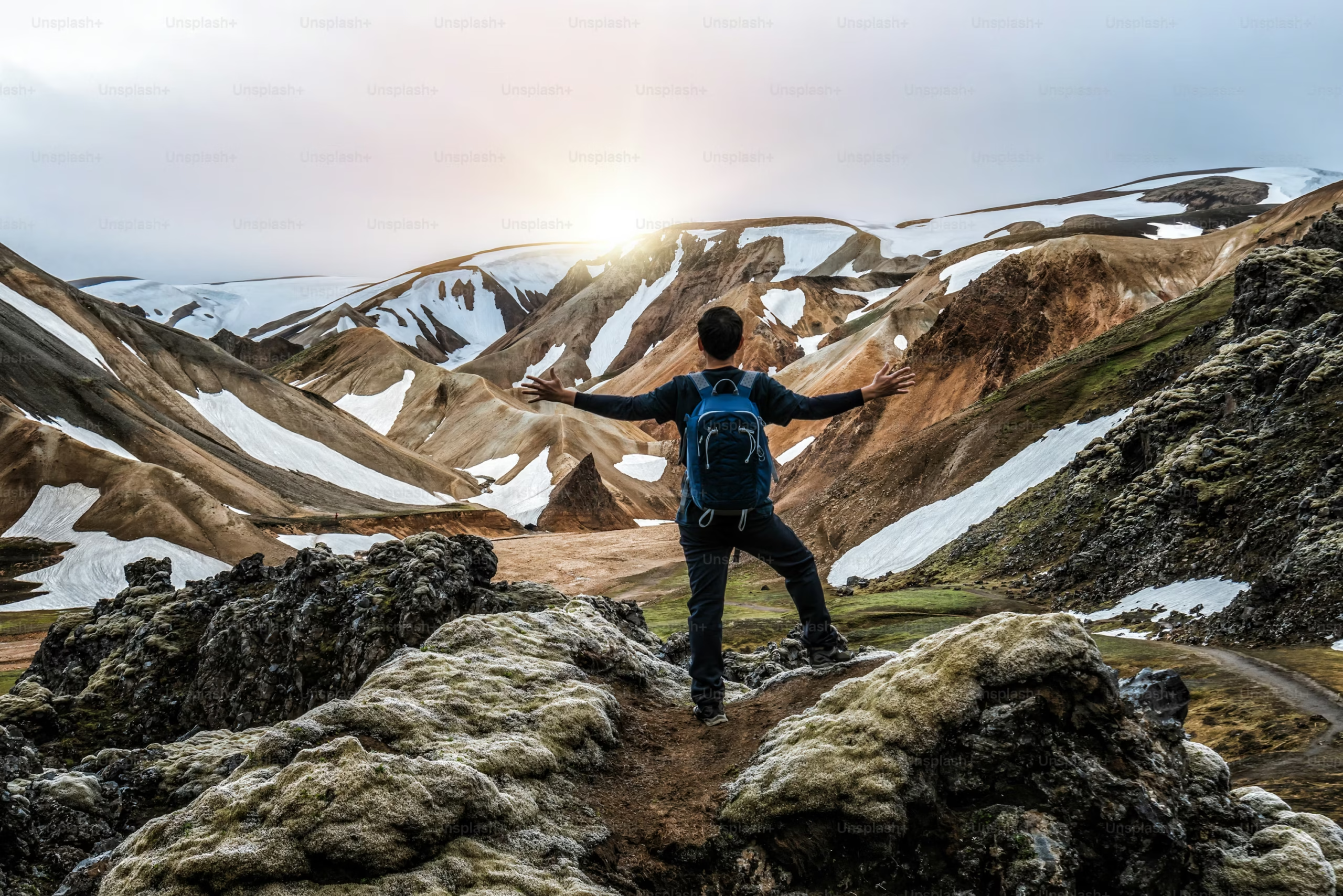
There is a story many people tell themselves about travel. The story goes that travel is expensive. That seeing the world requires saving for years, spending on premium hotels, booking business class flights, and generally having the kind of money that most ordinary people do not have lying around. So they wait. They put travel on the list of things they will do someday, when they earn more, when the savings account looks healthier, when the circumstances are finally right.
The waiting goes on for a long time. And in many cases it goes on indefinitely because the circumstances that feel necessary for travel somehow never quite arrive.
The story is wrong. Or at least it is far less true than most people who believe it have actually tested. Budget travel is real, it is genuinely enjoyable, and it is practised by millions of people all over the world who have discovered that the quality of a travel experience has almost nothing to do with how much money is spent on it and almost everything to do with how thoughtfully it is planned and how openly it is approached.
This blog is going to talk about budget travel honestly and practically. Not in the way that says you should sleep in dormitory beds and eat nothing but instant noodles and call it an adventure. But in the way that says you can have genuinely wonderful travel experiences for a fraction of what people who have not thought about it carefully spend. You can see remarkable places, eat real local food, stay in comfortable and interesting accommodation, and come home with memories that last for life, all without spending in ways that create financial stress or debt.
The principles are learnable and the savings they produce are real. Here is how it works.
Why Budget Travel Is Not What Most People Think
The phrase budget travel carries connotations for many people that are worth examining before we get into the practical details. It sounds like deprivation. Like the travel experience with everything good stripped out. Like spending two weeks being uncomfortable so you can technically say you went somewhere.
This is not what good budget travel looks like. Good budget travel is not about deprivation. It is about prioritisation. It is about being deliberate with where your money goes and ruthless about eliminating the spending that does not add genuine value to your experience, so that you have more to spend on the things that actually matter to you.
The traveller who books a mid-range international hotel in a major tourist district, eats at the tourist-facing restaurants with their tourist-facing prices, takes organised tours that triple the cost of seeing things independently, shops at airport shops and hotel minibar prices, and books flights without comparison shopping is not having a better experience than the budget traveller. In many cases they are having a worse one. They are staying in generic international spaces rather than locally owned accommodation with genuine character. They are eating food designed for foreign palates rather than what local people actually cook and eat. They are seeing attractions as part of a group rather than at their own pace and on their own terms.
The budget traveller who has done the research, who knows where to find the interesting local guesthouses and the places where locals eat, who understands how to get around independently on local transport, and who spends their money on genuine experiences rather than on the padding of excessive comfort infrastructure, is often having a richer and more authentic travel experience while spending a fraction of what the packaged tourist spends.
The reorientation from expensive travel to budget travel is not a downgrade. For most destinations and most travel styles, it is genuinely an upgrade in the quality and authenticity of the experience.
Transport: Where the Biggest Savings Live
For most trips, transport is the single largest expense. Getting to your destination and getting around once you are there are costs that can vary enormously depending on how you approach them, and the decisions you make here have more impact on your overall budget than almost anything else.
For international travel, flights are the dominant cost. The gap between the highest and lowest fares for the same route can be enormous, sometimes by a factor of three or four for the same cabin class on the same route. The main variables that determine where in that range you land are how early you book, how flexible you are about dates, whether you are willing to consider less convenient routings, and which tools you use to compare prices across airlines.
Booking early generally produces lower prices for popular routes and peak travel periods but this is not a universal rule. Many airlines release unsold inventory at discounted prices close to departure and the right late deal can be spectacular. Learning the pricing behaviour of the routes you travel most frequently helps you develop a feel for when to book and when to wait.
Date flexibility is one of the most powerful levers available to budget travellers. A flight on a Tuesday or Wednesday is almost always cheaper than the same flight on a Friday or Sunday. Travelling in the shoulder season for your destination, the weeks before or after the peak tourist period, produces substantially lower prices for both flights and accommodation while often delivering better weather and fewer crowds than the peak period itself. Mid-July is one of the most expensive times to visit most European destinations. Late September or early October delivers similar or better conditions at dramatically lower prices.
Using flight comparison tools and setting up price alerts for routes you are considering allows you to track price movement over time and to catch sales and drops that are not widely advertised. Google Flights, Skyscanner, and similar tools all offer price alert functionality that sends you a notification when the price for a specific route drops below a threshold you set. This costs nothing and can save significantly.
Within your destination, how you get around has a major impact on both your budget and your experience. Local transport, which means the trains, buses, ferries, and shared vehicles that local people use, is almost always dramatically cheaper than tourist-facing transport options and often provides a much more genuine experience of the place you are visiting. Taking a local overnight train rather than a domestic flight saves on both the fare and a night of accommodation. Taking a local bus between cities rather than a tourist shuttle moves you through the landscape at a pace that allows you to see it rather than jumping over it.
In India, the train network is one of the greatest budget travel assets available. Booking train tickets early through the IRCTC system secures access to a vast, affordable network that connects most significant destinations in the country. Second AC class provides comfortable, air-conditioned overnight travel at prices that are genuinely accessible and the experience of waking up as the landscape changes outside the window of an overnight train is one of the authentic pleasures of travel in India.
Accommodation: Thinking Beyond the Hotel
Accommodation is the second largest budget item for most trips and it is another area where creative thinking produces significant savings without any real sacrifice in comfort or experience.
Hostels have evolved enormously from the basic dormitory image they carry in many people’s minds. Modern hostels, particularly those in popular travel destinations that have invested in their product, offer private rooms as well as dormitories, have social spaces that facilitate meeting fellow travellers, often run events and activities that organically build community, and provide a base in the middle of the action at prices that can be a quarter or less of what a comparable hotel charges. The social dimension of hostel culture is genuinely one of its advantages rather than simply a compromise of privacy. Some of the most interesting travel conversations and some of the most useful local knowledge come from fellow hostel guests.
Guesthouses and locally owned small hotels are the backbone of budget accommodation in most travel destinations and they represent some of the best value and most authentic accommodation available anywhere. A family-run guesthouse in a Rajasthani town, a small lodge in a Himalayan village, a beach-facing room in a locally owned property in Goa, these are not inferior to the international chain hotels down the road. They are often superior in character, in the quality of local knowledge available from the people running them, and in the contribution they make to the local economy.
Homestays provide the most immersive accommodation experience available in any destination and are often very competitively priced. Staying with a local family, eating meals that the family prepares, and having access to the genuine daily life of a place rather than the tourist version of it is something that no hotel experience, however expensive, can replicate. Homestay platforms and networks have made finding genuine homestay accommodation easy in most travel destinations.
House sitting is an option that experienced budget travellers know about and that most beginners have not considered. House sitting involves staying in someone’s home while they are away, typically in exchange for caring for the property and any pets. Platforms that connect property owners with house sitters exist for destinations across the world and the arrangement can provide free accommodation in attractive properties for extended periods. It requires building a profile and track record on the relevant platforms but the cost savings for long-term or frequent travellers are extraordinary.
Camping, where available and where appropriate equipment is carried, provides access to some of the most remarkable accommodation experiences available in any travel destination. Camping in the Spiti Valley, on a Himalayan trek, in a national park, or in a coastal wilderness is not roughing it. It is having direct, unmediated access to the landscape in a way that any built accommodation necessarily distances you from.
Food: Eating Well for Almost Nothing
Food is one of the great pleasures of travel and it is also one of the areas where budget travellers often eat better than expensive ones because they are eating where local people eat rather than where the prices have been calibrated for tourist wallets.
The street food and market food available in most travel destinations, particularly in Asia, Africa, and Latin America, is often the best food in those places. The flavours are genuine, the produce is fresh, the cooking reflects generations of local knowledge, and the prices are a small fraction of what a sit-down tourist restaurant charges for an inferior imitation of the same food. Learning where local people go for their daily meals is one of the most valuable things a budget traveller can do for both their food experience and their budget.
Cooking for yourself, where accommodation with kitchen facilities makes it possible, is the most dramatic cost reducer available for food expenses. Buying produce from local markets, cooking simply, and eating in rather than out for some meals can reduce daily food costs by a substantial amount on longer trips without reducing enjoyment if you approach the market visit and the cooking as part of the travel experience rather than as a chore.
Eating the lunch menu rather than the dinner menu at restaurants that serve both is a specific tactic that produces significant savings in many destinations. The same quality of food and cooking is often available at midday for substantially less than the evening meal price. Having your main meal at lunchtime and a lighter, simpler meal in the evening is both a money-saving strategy and one that aligns with how many local populations actually eat.
Avoiding tourist-facing restaurants in obviously tourist areas does not require much research but it requires being willing to walk a few streets away from the main tourist drag. The price differential between the restaurant on the main square with photographs of every dish in the window and the restaurant two streets away where local workers have their lunch can be three or four times even for similar food. Your feet and your stomach will both thank you for the short walk.
Attractions and Activities: Getting More for Less
Seeing and doing things at your destination is where travel converts from movement into experience and it is another area where creative thinking produces significant value.
Free and low-cost attractions make up a surprisingly large proportion of what is most valuable to see in most destinations. Walking through a city’s old quarter, sitting in a public park, visiting a local market, wandering through a neighbourhood that reflects the everyday life of the place, climbing a public viewpoint, attending a religious festival or local celebration, walking along a coastline or through a natural landscape, these are all experiences that either cost nothing or cost very little and that are often more authentic and more memorable than the ticketed attractions that everyone feels obligated to visit.
Museum free days, which many public museums in India and internationally offer on specific days of the week or month, allow access to significant cultural institutions at no cost. Planning your itinerary to include museum visits on free days is a simple, costless form of budget optimisation.
Group travel and tour booking for activities that are more enjoyable in company, such as rafting trips, cooking classes, guided hikes, and cultural experiences, can be significantly cheaper when you join an existing group rather than booking a private experience. Asking at your accommodation whether other guests are interested in sharing costs for specific activities is a social and financial strategy that frequently works.
Booking activities directly rather than through accommodation desks or tour agency intermediaries consistently produces lower prices. The accommodation desk or tour agent is earning a commission on what they book for you and that commission comes out of your budget rather than theirs. Booking directly with the activity provider, which is usually straightforward, eliminates the middleman cost.
Planning and Research: The Work That Makes It All Possible
Budget travel is not primarily about being poor or being willing to suffer. It is primarily about the quality of your planning and research. The travellers who spend the least and experience the most are almost always the ones who have done the most homework before they left.
Understanding the real cost of living in your destination before you arrive allows you to calibrate realistic daily budgets and to recognise immediately when you are being overcharged. Prices in tourist areas are designed for people who do not know what things actually cost. Knowing what a rickshaw ride, a plate of food, a litre of water, and a night in a decent guesthouse actually costs in the place you are going makes you a much harder person to overcharge.
Travel blogs, forums, and communities written by people who have recently travelled to your destination provide current, practical information that guidebooks, which are often years out of date, cannot provide. The specific guesthouse recommendation, the current state of the trail, the recent opening of a worthwhile attraction, the practical advice about local transport options, all of this is available from the community of travellers who have been where you are going more recently than any published guide.
Building itineraries that make geographic sense rather than jumping between distant locations wastes both time and money on transport. Planning a route that moves logically through a region, seeing what is between your starting point and your ending point rather than doubling back or crisscrossing, reduces total transport cost and often reveals places that are worth visiting precisely because they are not famous enough to be in every guidebook.
Travelling slowly is one of the most consistently endorsed principles of budget travel. Moving between destinations every day or two requires paying for transport every day or two and often means arriving in places too briefly to find the good local food spots and the interesting neighbourhoods away from the tourist centre. Staying in one place for a week, getting to know it properly, finding your favourite breakfast place and your favourite local walk and the person at the market who has the best mango, is both cheaper and typically more satisfying than a rushed checklist approach to covering as many places as possible.
Budget Travel in India: A World Class Destination for Smart Travellers
India is one of the best destinations in the world for budget travel and Indian travellers exploring their own country have access to an extraordinary range of experiences at prices that make the country one of the most affordable and most rewarding travel destinations anywhere on earth.
The cost of daily life in most Indian destinations outside of the premium tourist infrastructure is genuinely low. A thali at a good local restaurant provides a complete, nutritious, and often genuinely delicious meal for a few hundred rupees. A second-class air-conditioned train ticket covers enormous distances at prices that make the equivalent car journey look expensive. A comfortable, clean room in a family-run guesthouse in most Indian cities and towns is accessible at prices that would be considered extraordinary in almost any other country.
The diversity of India as a travel destination means that budget travellers can pursue completely different types of travel without leaving the country. The desert landscapes of Rajasthan, the backwaters of Kerala, the high mountains of Ladakh and Himachal Pradesh, the temples and ghats of Varanasi, the colonial architecture of Kolkata, the beaches of Goa and the Andamans, the wildlife of Madhya Pradesh, the hill stations of Tamil Nadu, the ancient ruins of Hampi, the tea gardens of Darjeeling, all of it is accessible on a budget that makes comparable international travel look extraordinary.
The Indian Railways network, for all its occasional unpredictability, is one of the great systems of budget travel infrastructure in the world. Overnight trains that cover the distances between major cities while you sleep in a comfortable berth, eliminating the cost of a night’s accommodation while also covering significant ground, are one of the genuine structural advantages of budget travel in India. Learning to use the IRCTC booking system, to understand the class options available, and to book early enough to secure berths in the classes that offer the best value is a skill that repays the investment of learning it many times over.
Mindset: The Most Important Budget Travel Tool
After all the practical strategies, the most important element of successful budget travel is mindset. Specifically, the willingness to engage with a destination on its own terms rather than insisting that it conform to the standards and expectations of home.
Budget travel requires a level of comfort with uncertainty, with flexibility, and with things not going exactly as planned. The guesthouse you booked turns out to be noisier than the reviews suggested. The bus you planned to take does not run on the day you expected. The restaurant everyone recommended is closed for a local holiday. These things happen in all travel but they happen more frequently in budget travel because you are operating closer to the realities of how places actually work rather than in the insulated bubble of premium tourism infrastructure.
The traveller who responds to these moments with curiosity and problem-solving rather than frustration and demands for the holiday they imagined ends up in interesting situations that become the stories worth telling. The alternative guesthouse you find when the first one does not work out is often better. The bus you take instead goes through a village worth stopping in. The closed restaurant leads you to the place around the corner that you would never have found otherwise.
Openness to the unexpected is both a survival skill for budget travel and the quality that most reliably produces the moments that make travel worth doing in the first place.
Conclusion
Budget travel is not the consolation prize for people who cannot afford to travel properly. It is a skill, a practice, and for many of its practitioners a genuinely superior way of experiencing the world.
The travellers who spend less and experience more are not lucky. They are prepared. They have done the research. They understand the costs of their destination before they arrive. They make deliberate choices about where their money goes and they are ruthless about not spending on things that do not add genuine value to their experience. They travel slowly enough to actually know the places they visit. They eat where local people eat and stay where genuine hospitality happens rather than where corporate standardisation has been perfected.
The practical tools are all available and most of them are free. Flight comparison tools, price alert systems, hostel and guesthouse platforms, travel community forums, the Indian Railways booking system, maps of local markets and neighbourhoods, the advice of other travellers who have been where you are going more recently than any printed guidebook. All of this exists and all of it is accessible to anyone willing to spend the time with it before they leave.
The savings that good budget travel produces are not trivial. A traveller who applies these principles consistently can stretch the same amount of money to cover two or three times as much travel as one who does not. That is not a small difference. It is the difference between seeing one destination and seeing three. Between a short trip and a long one. Between travelling occasionally when circumstances align and travelling regularly as a genuine part of how you choose to live.
Travel does not require wealth. It requires curiosity, preparation, flexibility, and the willingness to engage with the world as it actually is rather than as you wish it would be arranged for your comfort. These are qualities that can be developed and that cost nothing.
The world is large and remarkable and most of it is more accessible than you have been told. Pack what you need, leave behind what you do not, do your research, book early where it matters, be flexible where it helps, and go.
The experiences waiting for you are genuinely worth having. And they cost less than you think.